I went to my first hackathon in 2022, when I was just a 19yo 1st year computer science student. My team didn’t win, but it was an amazing experience that pushed me to regularly participate to more hackathons.
Fast forward 4 years and I’ve went to a dozen hackathons across the globe (Italy, Thailand, USA, Taiwan, Belgium, France of course), met awesome people, built projects I’m proud of, won over $35k in cash prizes, got some job opportunities…
Some of the best memories I have in my 23 years of existence are related to these events, so hackathons really holds a special place in my heart.
This post is a reflexion on the current state and evolution of hackathons, especially in light of the development of AI, but also an attempt to define hackathons, or rater the different types of hackathons, as I think there are very different ways to view it.
What are hackathons?
The definition you would find online is something like
A hackathon is a fast-paced, collaborative event where people work together intensively (usually over 24 to 48 hours) to build a new software or hardware prototype.
The idea is simple: you put people in a room, give them a theme or a specific technology to use, and a deadline.
People form teams (or hack solo), trying to create the best project, or at least the best Proof of Concept of it, with the short amount of time they have, meaning a lot of caffeine and limited sleep (or none at all for the craziest hackers).
The result is truly amazing: people that didn’t know each other 5 minutes ago discussing, exchanging ideas, combining their skills to form teams, later stumbling upon a bug at 3am that forces them to pivot their idea…
Drinks & food are generally free onsite, so its really a buzzing environment during the whole event that is very stimulating to work in.
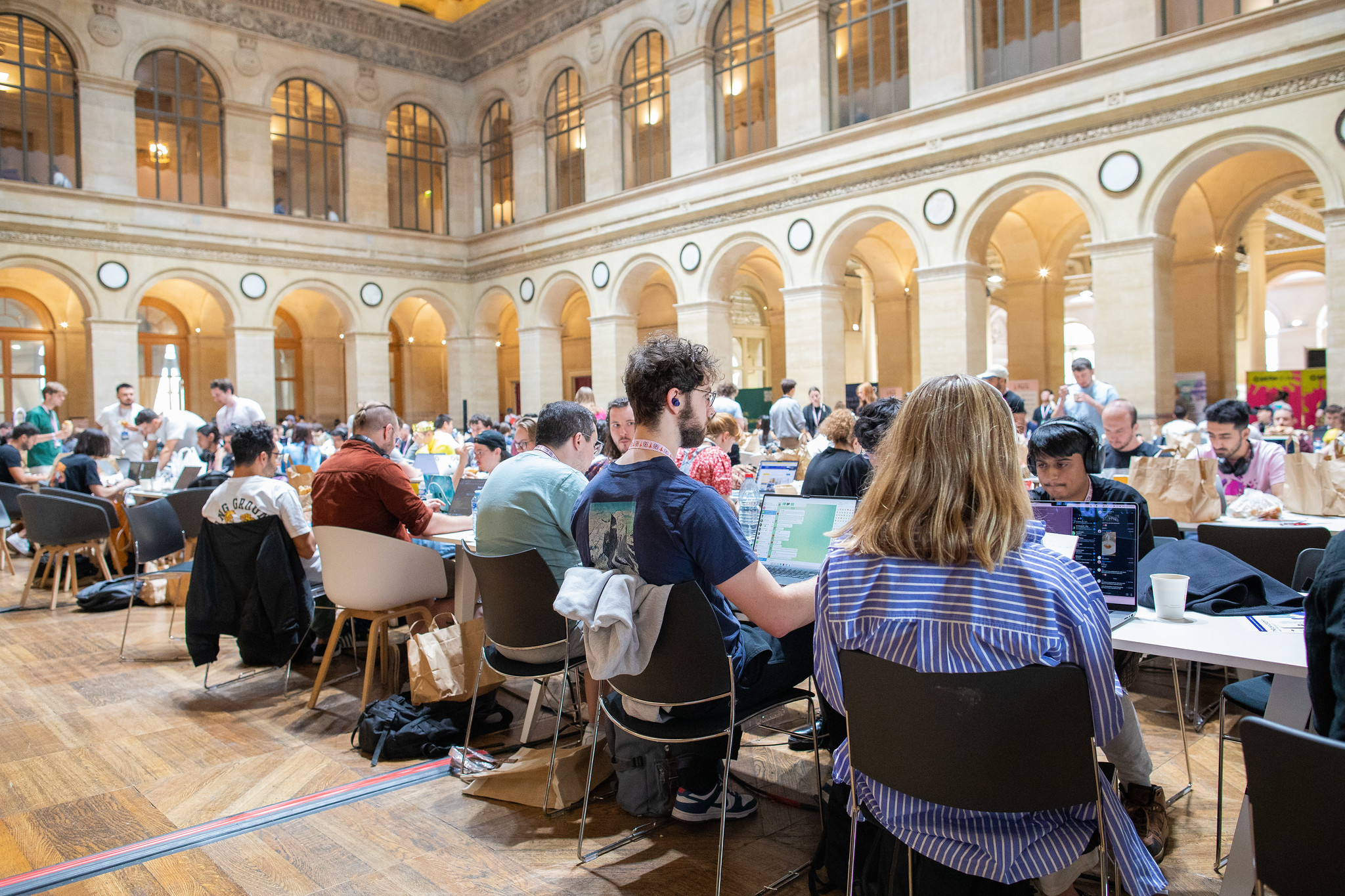 A hackathon in Paris in 2023
It also helps you develop a lot of different skills:
- Time management & feature prioritization, 36 hours goes a lot faster than you usually think, you have to take as much shortcuts as you can to build something correct in such a short timeframe
- Team coordination and complementarity, to be able to deliver a good product by the end, you don’t have time to discover a whole new field you don’t have at least some knowledge about beforehand
- Presenting & pitching your idea, which might seem trivial but actually is hard to nail, especially in this setting where most people are introverted engineers
- Sharpen your technical skills by discovering new technologies, having to solve issues and iterate fast
- and a lot of other smaller stuff!
With that settled, let’s go back to my original idea: there are a lot different reasons for somebody to engage in a hackathon, and various ones too for a company to organize one, which lead to several types of hackathons.
Types of hackathons
We can split hackathons in 3 categories, which aren’t always exclusive (some might fit in multiple categories) but represent the different objectives I see for an organizer.
Problem-solving
The first one is hackathons focused on a specific problem that a company comes up with rather than a broad thematic to build around.
One of the most well known hackathon series that would fit here is the NASA Space Apps Challenge, where participants help build working solutions to actual challenges the NASA faces.
Hackathons organized internally inside companies can also fit here, even though I would probably differentiate those too in their own specific categories as they don’t always match with what really makes hackathon great (melting pot of participants and not employees of the same company, driven by innovation and not semi-forced into a company event and so on).
The objective here is pretty obvious, get ideas and solutions for the given problem, in addition to the ones detailed below in classic hackathons.
Testbed
Here, companies come with a new product (or a new version of it), like an API, SDK… something generally targeted to developers, that isn’t yet released publicly.
The objective is to get people to try it, identify friction points & bugs, maybe serve as a small stress test of load if applicable, get feedbacks on what could be better…
Having participated mostly to blockchain hackathons, I’ve seen this objective from sponsoring enterprises frequently as the domain is perfect for it (frequent innovations & new technologies, and very technical / developer-targeted field).
Outside of the blockchain ecosystem I think these are less common than the 2 other categories, but can still be seen here and there.
Classic competition
Finally, the most classical form of a hackathon is just a broad theme, not focused on a specific problem or a new technology, purely focused on core definition of a hackathon:
build something impressive in 36 hours
This is generally co-organized with big companies (hyperscalers, like Amazon’s AWS or Google’s GCP, or more recently AI labs such as OpenAI or Anthropic), fueled by credits given to access their services for free, with the goal of familiarizing potential customers of their products with it, reeling them into their ecosystem.
It can also be a direct bridge to the startup programs these companies generally have if some really good projects emerge from the hackathon and that their team want to push further.
You can also see these events organized by VC funds or startup incubators for the same goal of detecting talented individual, teams and projects at the earliest stage possible.
Additionally, its also a good source for companies to find talents to join their workforce (internships are often explicitly offered in the prizes for student-targeted hackathons)
What I enjoy(ed)
Before getting into the reasons why I personally love doing hackathons, a quick list of the goals for participants is important to make, because just like the companies that are organizing them, hackers also have various motivations:
- Sharpen all the skills listed in the introduction: technical knowledge, organization, communication, pitch…
- Create a cool project that you can be proud of, potentially put it on your portfolio later to showcase your skills and help you find a job
- Directly aim for a job opportunity / internship with the hackathon sponsors
- Purely competitive, aiming for the win and the cash prizes
- Use the hackathon as a launchpad to start a project you’d like to work on, potentially as a real startup later
- Just for fun, to spend a cool weekend working on interesting problems (especially at problem-solving hackathons)
This list is probably extensible, but I fell like these are the main objectives of hackers.
For me, as for the majority, it’s a mix of pretty much everything.
I’d say I started mostly to sharpen my skills, enhance my portfolio and for fun.
Then as I got better and better at it, the competitive aspect became an important part too (I started travelling to different countries just for hackathons, so I had to get my money’s worth 😄).
I started winning important prizes at each hackathons I was going to, even though I was doing most of them as a solo hacker (making it obviously harder to produce a great project than a full team, but probably also easier to impress the jury if you manage to do it), so in addition to the rest it also became a motivation to see until when I could push my winning streak (managed to get to 7 consecutive hackathons with at least $2000 of cash prizes won).
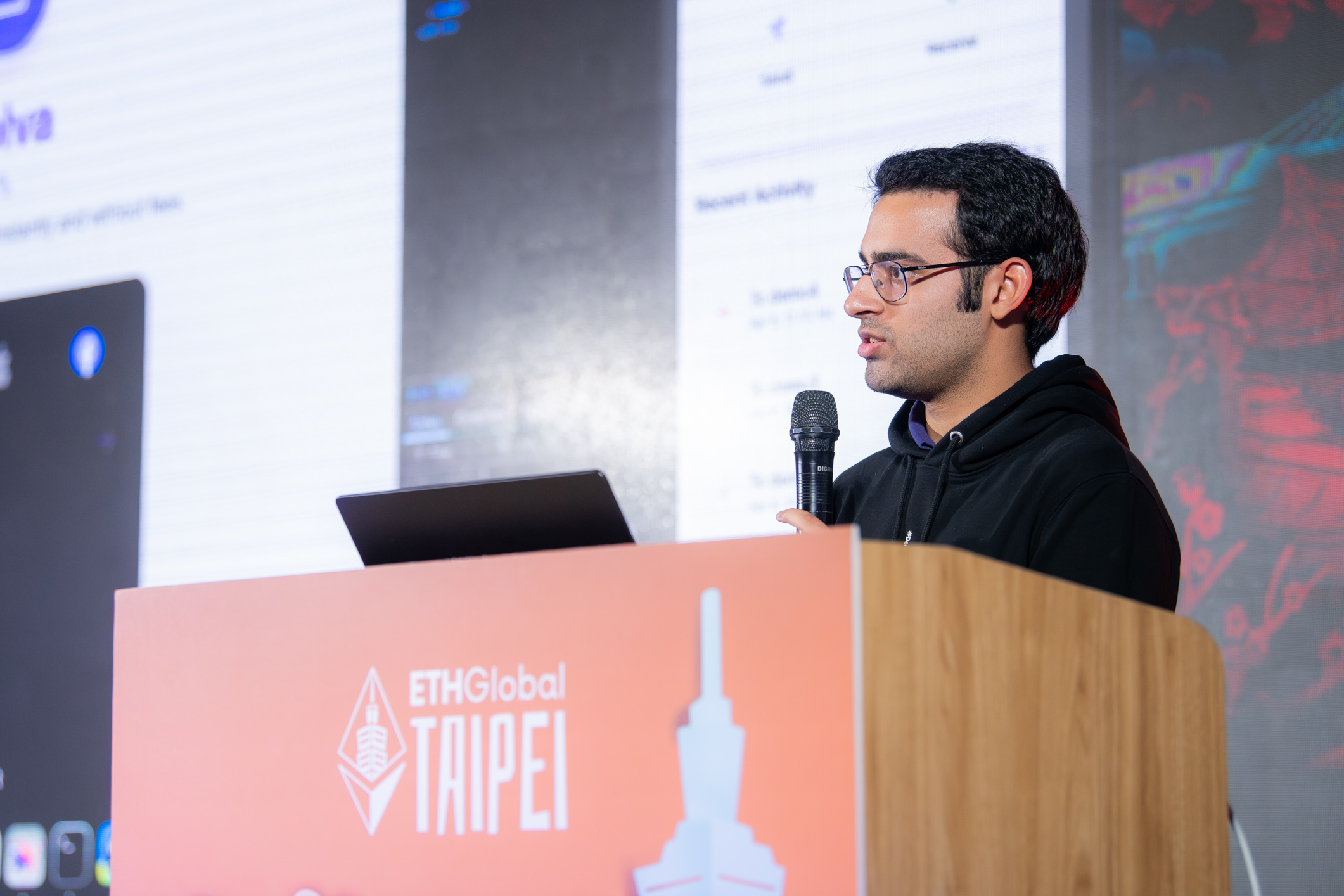 My pitch on stage in Taipei in 2025 after being awarded multiple prizes & the finalist title
Most of the fun I was getting was from discovering new technologies from the sponsors (as I stated earlier, I was participating mostly to blockchain hackathons, which fit very well in the testbed category with cutting edge technologies every time) and the struggle that came with it as there were frequently a lot of bugs that we had to investigate with the tech staff of the sponsors, finding hacky solutions to solve it at least temporarily for the hackathon to unblock all the hackers building on it.
Going alone in a foreign country to work intensively on a new obscure tech and trying to debug it a 3am with the staff is definitely a feeling I enjoy a lot.
It’s also very rewarding at the end to have a working project, which is a very similar satisfaction to programming in general, but in hackathons it’s increased tenfold by the short timeframe, the struggle with tools in alpha (the problem is more often in that tooling than in your usage of it) and by the potential prizes you can get (you have no immediate reward or bonus like that in your day to day job).
Finally, for me it never really was about finding job opportunities or launching a real project, I already had professional opportunities I enjoyed and I never really considered hackathons (or at least the ones I participated to) as the best way to initiate a startup creation (although it’s something that could interest me if I have an opportunity to do so in the future).
Despite that, some of my participations led to job opportunities, like in 2024 when after winning a prize in the AI track of Near Protocol I ended up working for them in freelance here and there for a few months.
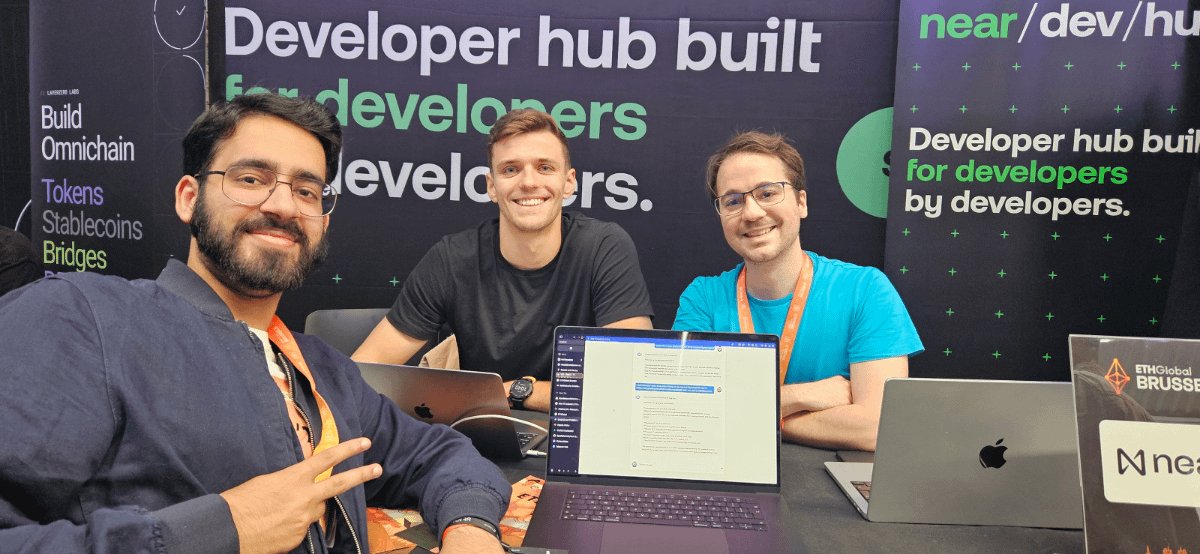 My hackathon pitch to Near in Brussels in 2024
Impact of AI
And then Artificial Intelligence tools emerged at a record pace and transformed a lot of aspects of our society, hackathons (and more broadly the job of a software engineer) included.
With tools like Claude Code, Codex or Cursor, you can now run agentic workflows & loops, allowing you to iterate faster than ever, especially in hackathons where you are trying to generate a PoC / MVP and not a complete & perfect product.
This drastically improves the quality of the submissions you can make (you can spend more time focusing on the idea, the user journey, the demo…) but also, in my opinion, reduces at the same rate the amount of fun I’m having at a hackathon.
The struggle I was describing above, with the mental reward that goes with solving the issue, is no longer present as this step is now delegated to an agent that does everything for you.
In an era where everybody is equipped with tools that make creation several times faster, an event to create the best project in a small timeframe becomes less of a team effort, combining different set of skills, and more a way to see who’s got the best agentic setup, as the difference it can make is similar to having one or more additional human teammates.
But for me, who was enjoying hackathons for the technical complexity/challenge, the pressure & motivation of the deadline to do everything correctly alone while competing against teams of 2,3,4 or even 5 people, it’s less interesting than before.
Don’t get me wrong, hackathons are still great, the idea you come up with still matters (even more than before), it’s incredible for less technical audiences that are now able to bring their ideas to life in a few prompts, and it as a lot of other benefits.
It just reduces the things I personally enjoyed hackathons for, while those that other people might enjoy.
Note that this take on AI is scoped to hackathons, it’s also transforming the job of developers, where some points might be similar to what I mentioned (the struggle then reward cycle is gone) but others completely different (AI boosting the development speed of a product is incredible, with some downsides as always but it’s a net-positive imho).
It’s really the nature of hackathons to combine a PoC in a short timeframe that was completely challenged by AI.
Of course, this is mostly true for testbed hackathons, the ones I was mainly doing.
For problem-solving one, this is a huge revolution, we can now tackle an infinitely larger panel of problems (hackathons or not).
I’ve seen this “Rare Disease, Real Kid” hackathon pop up recently, which is one of many examples of the possibilities opened to us with the boost given by AI tooling.
Conclusion
So, are hackathons dead? Definitely not.
Are they facing major changes with AI, like various parts of our society, especially in the tech ecosystem? For sure!
Some people will love it, some people won’t, such is life.
For me, it’s definitely a downgrade from the hackathon experience I enjoyed, which is exacerbated by other factors that came into play at the same time:
- The blockchain ecosystem is facing a downturn, meaning less choice of the testbed hackathons I was accustomed to
- I’m getting old. You’ll probably laugh if you scroll back to the introduction where I said I was 23 years old, but I’m serious. I just finished my studies, have a full-time job that I appreciate, other passions that also eat my time ( finance , reading books… mostly about finance & investments 😄, chess…) and side projects that I couldn’t have created & maintained before AI.
When I see the new generation of 19yo students, participating to their first or second hackathon, I definitely feel the difference in sleep deprivation resistance to only name one thing. Of course in a general sense I’m still young, with a lot of ambition and plans for the future, but when it comes to hackathons my prime is probably behind me.
With all of that said, the days of doing 3 to 4 hackathons per year are over for me.
I’ll definitely participate to some here and there, maybe more on the problem-solving side, but pre-ai hackathons will keep holding a special place in my heart.